Our Structure
FIC Governance
The FIC is an operationally independent and autonomous national financial intelligence centre, and is responsible for administering the FIA and combating ML/TF/PF activities in collaboration with stakeholders.
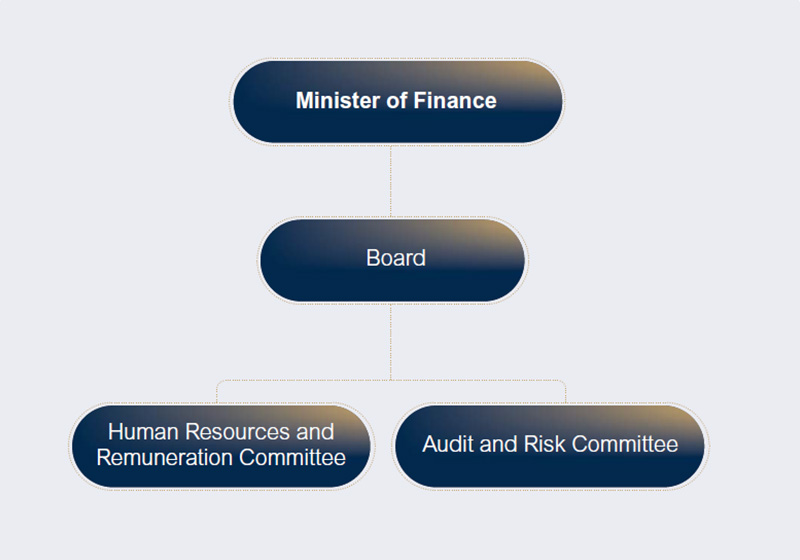
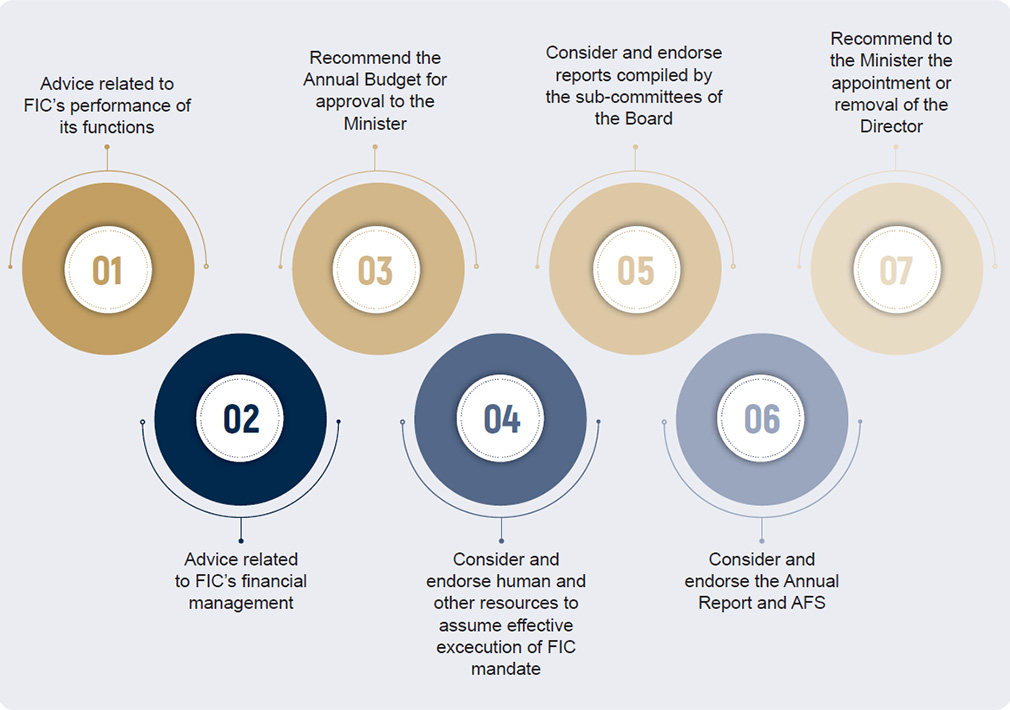
The FIC is governed by an independent Board, which was established in terms of the FIA. The Board provides administrative and governance oversight to the FIC. In consultation with the Director, the Board determines an appropriate level of delegation of authority while reserving specific strategic and decision-making functions to maintain accountability and oversight.
The Board exercises its oversight function through the following two sub-committees:
- Human Resources and Remuneration Committee
- Audit and Risk Committee
Governance Framework
Governance Purpose
Composition and Appointment
The Board’s members are appointed by the Minister of Finance in terms of the FIA for a five-year term. In alignment with the NamCode and other governance principles, the establishment of a non-executive Board ensures independence from the operational functions of the FIC. The current Board reflects a balanced mix of skills, expertise, and experience to effectively oversee and support the fulfilment of the FIC’s mandate.
During the reporting period, a director resigned due to potential conflicts of interest. The resignation was duly accepted and the vacancy will be filled in accordance with the FIA.
Meetings
Board meetings are held quarterly and extra ordinary meetings are convened as the need arises. During the review period, the Board held four ordinary meetings, two extra ordinary meetings, and eight sub-committee meetings. The extra ordinary meetings were held to discuss and approve the FIC’s budget and strategy for the 2025/2026 financial year.
Administrative Role of the Bank of Namibia
The Bank of Namibia (BoN) provides a comprehensive range of administrative support services to the FIC, as provided for under the FIA. The main areas of support include human resources, remuneration and payroll management, budget and financial accounting, office space and equipment, strategic communications, records management, and information technology support.

Risk Management and Assurance
Risk Management Framework
The Risk Management and Assurance Function was segregated from the BoN, reflecting the FIC’s evolution towards operational independence and governance autonomy.
The function plays a critical role in supporting the FIC’s mandate to assist with combating money laundering, the financing of terrorism, and proliferation. The FIC maintains a robust risk management framework, which is in alignment with international best practices.
During the review period, the Risk Management and Assurance Function conducted a comprehensive organisation-wide risk assessment. Through engagement with all functional areas, risks that could have a significant impact on the achievement of the FIC’s mandate as well as the progress made in addressing them were identified. These included reputational risks, people risks, operational risks, security risks, and cybersecurity risks.
The Senior Management Committee, the Board Audit Committee, and the Board continued to examine and monitor the risks identified and their defined response strategies.

Key Risk Mitigation Measures
The key risk mitigation measures includes:
- continuous monitoring and periodic reporting of the top risks in the FIC’s operations;
- risk assessments of the FIC’s different functions;
- approval of the Risk Management Policy; and
- approval of the Internal Audit Charter and Audit Plan.

Governance
The Board remains ultimately accountable for the overall process of risk management. As a specialised Board sub-committee, the Audit and Risk Committee assists the Board in fulfilling its risk management oversight responsibilities.
The implementation of risk management processes is a Management function, which fosters a culture where risk management is integrated into day-to-day operations and decision-making processes.
Organisation Risk Management Framework
The FIC maintains a robust risk management framework, which is in alignment with international best practices.
The framework includes:
- risk management policies;
- risk assessment methodology;
- the Risk Register;
- risk mitigation strategies; and
- monitoring and reporting.
Governance
The FIC is an operationally independent and autonomous national financial intelligence centre, and is responsible for administering the FIA and combating ML/TF/PF activities in collaboration with stakeholders.
Our Board
The FIC is governed by an independent Board, which was established in terms of the FIA.
Our Management
The Board exercises its oversight function through two essential sub-committees.
About Us
The FIC is the Financial Intelligence Unit of the Government of the Republic of Namibia.